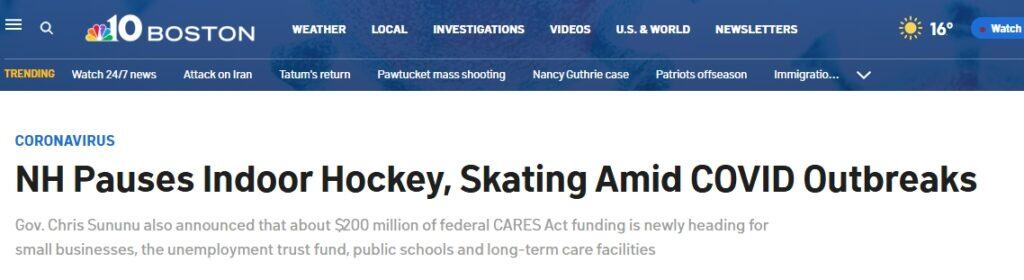
NH Pauses Indoor Hockey, Skating Amid COVID Outbreaks, Sununu Says – NBC Boston
Being a rink owner, operator, or hockey organization administrator 6 years ago this upcoming week was most likely one of the most stressful, consuming and difficult periods of your career. The COVID-19 lockdown in the USA officially began in mid-March 2020, with most states initiating stay-at home orders between March 15 and March 30, 2020. California was among the first states to implement a stay-at-home order on March 19, 2020.
Following the initial few months of lockdowns, masking and distancing, and then a summer period of unrest, the Fall and Winter months ramped up 14 day quarantines, mass testing and compete shutdowns of businesses and schools. The 2020-21 Hockey season was unlike any other. Cancellations of USA Hockey Nationals, Restrictions on border crossings to Canada for Junior Hockey players, High School Sr nights and graduations cancelled, and much much more.
Put aside ones political or religious affiliations, the Covid crisis and decision making that followed greatly impacted our children.
The COVID shutdowns had measurable and lasting effects on many kids’ mental health, academic progress, and social development. While experiences varied by family situation and community, researchers and educators have identified several clear trends.
🧠 Mental Health Impacts
1. Increased Anxiety & Depression
Studies from the Centers for Disease Control and Prevention (CDC) and the American Academy of Pediatrics reported:
- Significant spikes in anxiety and depression symptoms
- Increased emergency room visits for mental health crises
- Higher rates of suicidal thoughts reported among teens (especially girls)
Why?
- Social isolation
- Loss of routine and structure
- Family financial stress
- Fear of illness or losing loved ones
2. Social Development Setbacks
- Reduced peer interaction during critical developmental years
- Delays in social skills among younger children
- Increased screen dependence and reduced in-person communication skills
For middle school and high school students, missing milestone events (sports seasons, graduations, proms) contributed to feelings of grief and loss.
3. Behavioral Changes
Teachers and parents reported:
- Shorter attention spans
- Increased irritability
- More classroom behavioral challenges after returning in person
📚 Academic Impacts
1. Learning Loss
National testing data showed declines in:
- Math scores (most affected subject)
- Reading scores (moderate decline)
Students in lower-income communities were disproportionately impacted due to:
- Limited access to devices or stable internet
- Less academic support at home
2. Executive Function & Study Habits
Remote learning led to:
- Difficulty managing time
- Reduced accountability
- Weaker note-taking and organization skills
Some students returned to school academically behind but also lacking school stamina.
3. Attendance & Engagement Issues
- Increased chronic absenteeism after reopening
- Reduced motivation for some students
- Disengagement from school culture
Here are specific research links and summaries from credible studies that document negative effects of the COVID-19 pandemic on children’s academic learning and social development. These are direct or major peer-reviewed findings you can read for yourself:
📌 Academic and Learning Impacts
- Early Childhood and Social Cognition
This study found that preschool-aged children tested after pandemic lockdowns showed worse performance in key social thinking skills compared with pre-pandemic groups — especially for kids from lower-income families:
👉 The COVID‑19 pandemic and social cognitive outcomes in early childhood (Scientific Reports) - Kindergarten Development (Language, Social, Cognitive Skills)
Large U.S. research followed hundreds of thousands of kindergarteners and found decreases in language/cognitive development and social competence during the pandemic period:
👉 COVID‑19 Pandemic and the Developmental Health of Kindergarteners (JAMA Pediatrics) - Early Childhood Development Delays
A cohort study found that children exposed to the pandemic experienced delayed general development at age 5, with parental depression and fewer social interactions linked to stronger effects:
👉 Association Between the COVID‑19 Pandemic and Early Childhood Development (JAMA Pediatrics) - Learning Gaps and Academic Performance Worldwide
Researchers analyzing global achievement data documented a drop in student learning scores (especially in math & science) tied to how long schools were closed:
👉 (Academic preprint) The Learning Crisis: Three Years After COVID‑19 (arXiv.org) - Children with Special Educational Needs
Systematic research showed that children with learning differences had greater difficulties keeping up with schoolwork and social-academic engagement during closures and remote learning:
👉 Effects of COVID‑19 on educational performance of kids with special needs (ScienceDirect)
📌 Social Interaction, Behavior, and Development
- Social Cognitive Skills Reduced
The preschool study linked above also found that social reasoning and peer interaction skills were weaker in children after the pandemic — showing clear social development effects:
👉 The COVID‑19 pandemic and social cognitive outcomes in early childhood (Scientific Reports) - Social Skills and Peer Relationships
Surveys and ongoing tracking found that many parents report negative effects on children’s social skills development — including challenges connecting with peers and adjusting back to in-person interactions:
👉 Pandemic Hurt Children’s Social Skills, Mental Health Most (Gallup report summary) - Global Meta-Analysis on Emotional and Social Behavior
A systematic review of international studies reported increases in emotional problems and decreases in social and motor skills among preschool-aged kids during the pandemic:
👉 Effects of the COVID‑19 Pandemic on Early Childhood Development (MDPI systematic review) - Behavior and Social-Emotional Skills Linked to Pandemic Stress
Research on school-age kids showed that parent and child stress during lockdowns was linked to behavior problems and lower social-emotional functioning:
👉 Child behavior problems during COVID‑19 (PubMed)
By Andrew Trimble