Personal story… Following a 4-2 win with my Wolves 16U team just before the Christmas break in 2021, our team defeated North Shore Academy, which was ranked 15 spots ahead of us. It was a solid TEAM win. Our captain was coming back from a month -long injury, and although he was a leading point getter, I sheltered his minutes as he was coming back from an injury and another player was playing fantastic 200′ hockey when he was out. The captain still saw time 5v5, PK, and PP, but the other player was seeing time with another line, double shifting.
As a result of my decision, the Captain’s father followed me out of the rink after the game. From the lobby to my car, complaining about his sons ice time. How, and I quote “HE WANTS THOSE MINUTES.” Holiday Break couldnt come soon enough.- Andrew Trimble
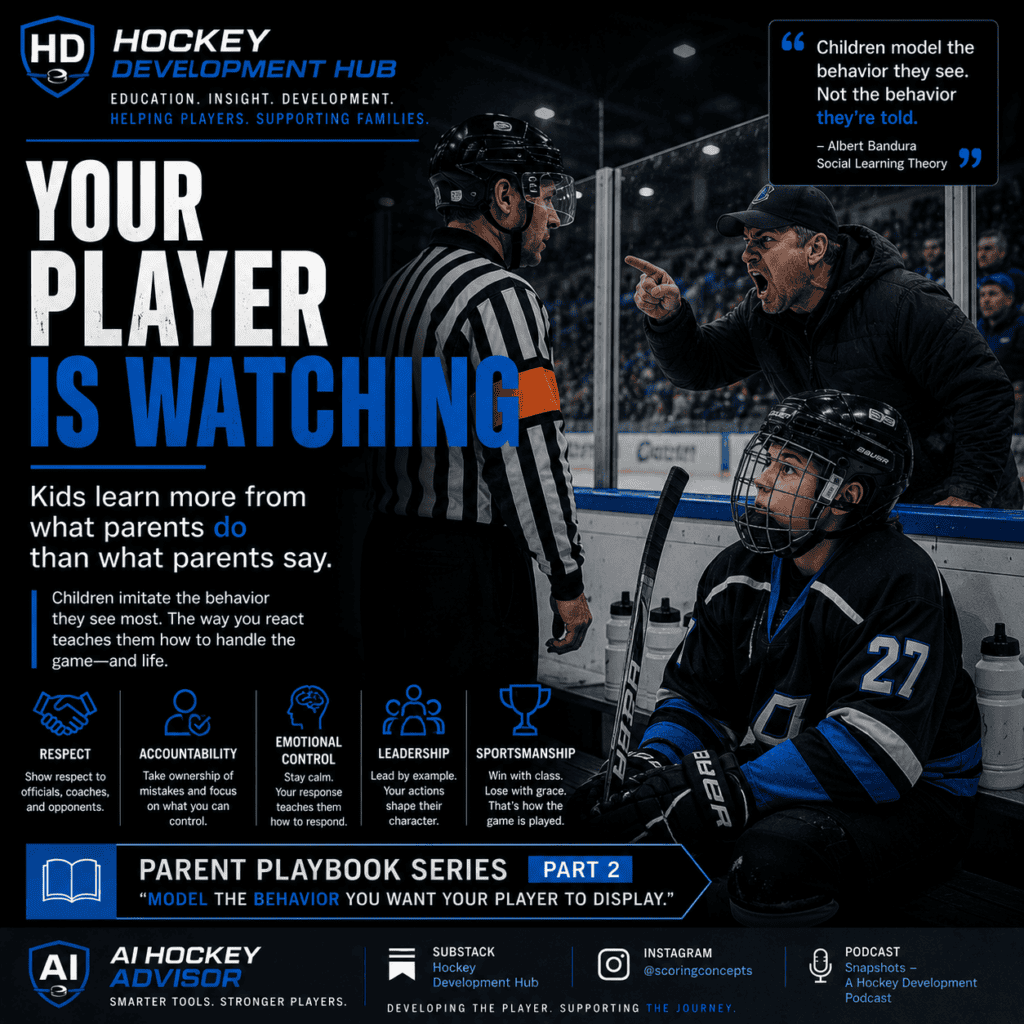
Parent Playbook Series — Part 2
Your Player Is Watching More Than You Think
Click here for downloadable Hockey Parent Playbook (Only .99 cents)- https://buy.stripe.com/dRm3cu6ihblYdNrfBd7ok0d
Walk into almost any youth hockey rink and you will eventually see it.
A parent disagrees with a call.
The referee misses an offside.
A penalty goes against their team.
And suddenly the yelling starts.
Most parents believe they are defending their child.
But what many do not realize is that their child is learning something far more important than whether the call was correct.
They are learning how adults handle adversity.
Kids Learn By Watching
One of the most established findings in social science is that children learn behaviors by observing the people around them.
Psychologist Albert Bandura’s work on Social Learning Theory demonstrated that children frequently imitate behaviors they observe from adults, even when nobody explicitly teaches those behaviors.
In simple terms:
Kids watch.
Kids learn.
Kids repeat.
Whether we realize it or not, parents are constantly modeling behavior.
What Happens When Parents Yell at Officials?
When parents repeatedly scream at referees, officials, coaches, or opposing teams, players may begin to internalize messages such as:
- Authority figures are the problem
- Mistakes are someone else’s fault
- Emotional outbursts are acceptable
- Respect depends on whether you agree with someone
- Losing is caused by external factors
None of those lessons help player development.
In fact, they often create athletes who struggle with accountability and emotional control.
The Best Players Handle Adversity
Hockey is full of unfair moments.
Bad bounces.
Missed calls.
Questionable penalties.
Unlucky breaks.
The players who ultimately thrive learn to focus on what they can control:
- Effort
- Preparation
- Attitude
- Response
Parents can reinforce those same habits.
Every time a parent stays composed during a difficult moment, they are teaching a lesson far more valuable than any postgame speech.
The Youth Sports Problem Nobody Talks About
Youth sports organizations across North America have increasingly raised concerns about spectator misconduct and abuse directed toward officials.
Many sports are now dealing with referee shortages because of ongoing verbal abuse from parents and spectators.
The reality is simple:
Kids notice everything.
They hear the comments.
They watch body language.
They see how adults react when things do not go their way.
A Better Example
Imagine two different players.
Player A hears:
“Ref! Are you kidding me?!”
Player B hears:
“Tough call. Keep competing.”
Which player is learning resilience?
Which player is learning accountability?
Which player is learning emotional control?
The answer is obvious.
What Great Hockey Parents Understand
Great hockey parents understand that development extends beyond skating, shooting, and skill work.
They are developing:
- Character
- Resilience
- Emotional intelligence
- Accountability
- Leadership
And those lessons are taught every single game.
Not through speeches.
Through example.
Because eventually your child may not remember a missed penalty call.
But they will remember how the adults around them handled it.
Parent Playbook Series Continues Tomorrow:
Part 3 — Parents Set the Standard
Continue Your Development Journey
AI Hockey Advisor helps parents, players, and coaches navigate:
- player development
- hockey IQ
- recruiting
- confidence
- training habits
- recovery
- communication
- long-term development
Follow:
- Hockey Development Hub (Substack)
- @scoringconcepts
- Snapshots – A Hockey Development Podcast
Helping hockey families navigate modern player development.
By Andrew Trimble