The Laconia Blueprint: Building a Sustainable Junior Hockey Organization
Over the years, I’ve had the opportunity to visit, work with, and observe junior hockey organizations across the United States and Canada. Some thrive for decades. Others disappear after only a few seasons.
Why?
The Hockey Development Hub is a reader-supported publication. To receive new posts and support my work, consider becoming a free or paid subscriber.
That’s the question that inspired this series.
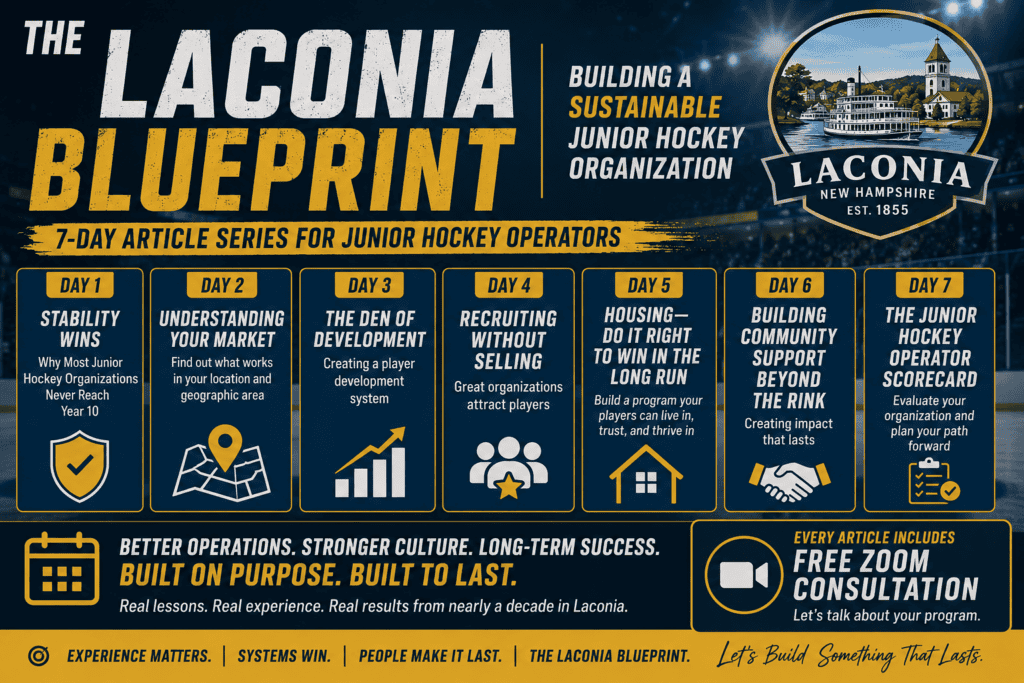
Starting tomorrow, I’ll be publishing a seven-part series called The Laconia Blueprint: Building a Sustainable Junior Hockey Organization.
This isn’t a theory series.
It’s not based on a business book.
It’s not based on a seminar.
It’s based on lessons learned while helping operate a junior hockey organization in Laconia, New Hampshire for over a decade.
One of the realities of junior hockey is that success is often viewed through a very narrow lens. Wins. Losses. Championships. Advancement numbers.
Those things matter.
But long-term sustainability requires much more.
It requires stable leadership.
It requires trust.
It requires community support.
It requires systems.
It requires culture.
Most importantly, it requires patience.
Many organizations spend enormous amounts of energy trying to find shortcuts. The next recruiting trick. The next marketing gimmick. The next roster move that will solve every problem.
In my experience, the organizations that last are usually doing something much less exciting.
They’re building.
Slowly.
Consistently.
Purposefully.
The goal of this series is to share some of the lessons we’ve learned along the way.
Over the next seven articles, we’ll explore topics that every junior hockey operator should be thinking about.
Part 1
Stability Wins
Why most junior hockey organizations never reach Year 10.
Part 2
Understanding Your Market
Finding out what works in your location and geographic area.
Part 3
The Den of Development
Creating a player development system that produces consistent results.
Part 4
Recruiting Without Selling
How honesty, relationships, and reputation attract the right players.
Part 5
Housing: Do It Right to Win in the Long Run
Why housing may be the most overlooked competitive advantage in junior hockey.
Part 6
Building Community Support Beyond the Rink
Creating impact that extends far beyond hockey.
Part 7
The Junior Hockey Operator Scorecard
A practical self-assessment for owners, operators, and leadership groups.
The purpose of this series isn’t to suggest there is only one way to build a successful organization.
Every market is different.
Every ownership group is different.
Every community presents unique challenges.
What works in Laconia may not work somewhere else.
But I believe every operator can learn from the experiences of others, and I hope these articles create valuable conversations throughout junior hockey.
At the end of the day, players deserve stable organizations.
Families deserve trustworthy organizations.
Communities deserve organizations that contribute beyond the rink.
And operators deserve resources that help them build something that lasts.
I look forward to sharing the journey.
Tomorrow we begin with Part 1:
Stability Wins: Why Most Junior Hockey Organizations Never Reach Year 10.
Free Junior Hockey Operator Consultation
As part of The Laconia Blueprint series, I will be offering a limited number of free Zoom consultations for junior hockey owners, operators, coaches, and leadership groups.
If you’d like to discuss organizational structure, recruiting systems, housing, player development, communication, culture, or long-term sustainability, I’d be happy to connect.
Schedule Your Free Zoom Consultation Below
scoringconcepts@gmail.com
About Andrew Trimble
Andrew Trimble is the co-owner of the New England Wolves Hockey Club, founder of Scoring Concepts, creator of AI Hockey Advisor, author, and hockey development coach.
Over the past decade, he has worked with thousands of players, families, coaches, and organizations while helping build one of New England’s most stable junior hockey programs.
His work focuses on player development, leadership, organizational systems, and helping hockey organizations create sustainable long-term success both on and off the ice.