The Laconia Blueprint Part 3
The Den of Development: Building a Player Development System
One of the biggest mistakes I see in junior hockey is organizations believing player development happens automatically.
A team hires a coach.
The Hockey Development Hub is a reader-supported publication. To receive new posts and support my work, consider becoming a free or paid subscriber.
Players show up.
Games get played.
And somehow development is expected to occur.
The reality is very different.
Development doesn’t happen by accident.
Development is a system.
That belief became one of the guiding principles behind what eventually became the New England Wolves Den of Development.
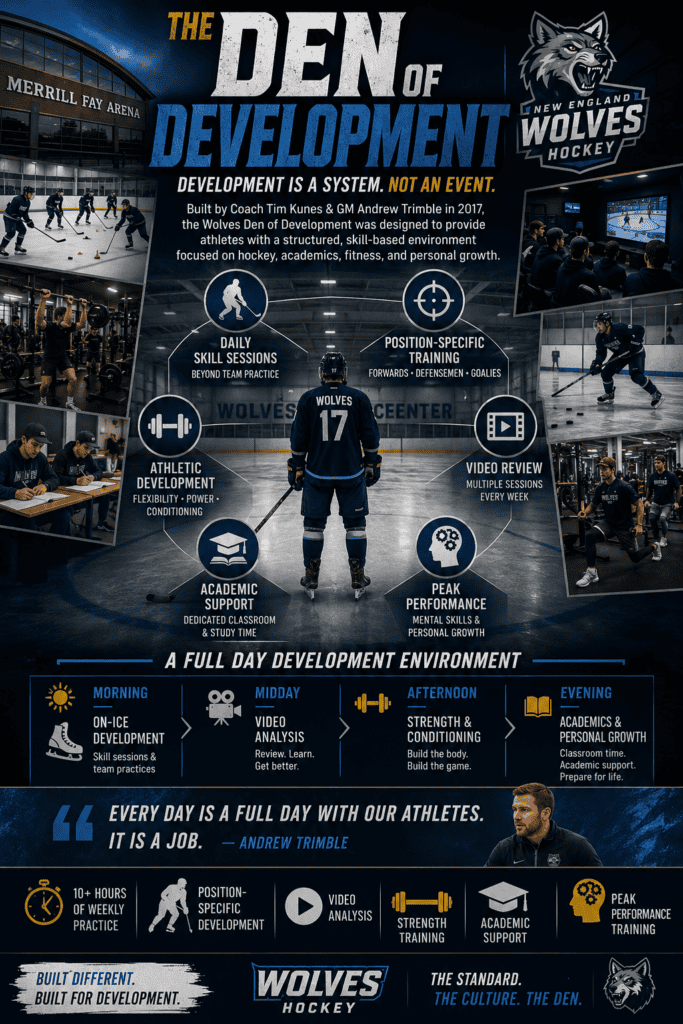
In the Fall of 2017, Head Coach Tim Kunes and I created the Den of Development model with a simple objective:
Create a structured environment where player development becomes part of everyday life.
Not just during practice.
Not just during games.
Every day.
Because if development is truly your mission, then every part of the day should support that mission.
Building the Den of Development
When we began evaluating junior hockey programs, we noticed many organizations operated on a fairly simple schedule.
Players would attend practice.
Play games.
Work out occasionally.
Then go home.
We believed there was an opportunity to create something more comprehensive.
The result was a development model built around several core components:
- Daily Skill Sessions in addition to team practices
- Position-Specific Training for forwards, defensemen, and goaltenders
- Specialized Off-Ice Workouts
- Multiple Video Sessions each week
- Peak Performance Counseling
- Academic Support and Classroom Time
- Individual Development Planning
The goal was to create an environment where players could consistently improve in every area that contributes to long-term success.
Every Day Has a Purpose
One of the philosophies behind the Den of Development is that development should not be limited to a one-hour practice.
Every day should have structure.
Every day should have purpose.
As I often tell families:
“Every day is a full day with our athletes. It is a job. Kids punch their clock in the morning and are either on the ice, in the video room, or doing a workout over the course of the entire day.”
That approach creates consistency.
Instead of asking:
“What are we doing today?”
We ask:
“What are we developing today?”
Those are two very different questions.
Position-Specific Development
One of the challenges in hockey development is that every position requires unique skills.
A defenseman doesn’t see the game the same way a forward does.
A goalie doesn’t train the same way a defenseman does.
Because of that, position-specific instruction became a major component of our model.
Forwards work on offensive habits.
Defensemen work on defensive details.
Goalies receive specialized instruction.
The objective is simple:
Train athletes according to the demands of their position.
Video Accelerates Learning
One of the most valuable tools we’ve utilized over the years is video.
Players often think they understand what happened during a game.
Video allows them to see what actually happened.
It removes emotion.
It removes assumptions.
It creates teaching opportunities.
Some of the greatest improvements we’ve witnessed have occurred inside the video room.
Because learning often begins when athletes can clearly see their own decisions.
Strength Training and Athletic Development
Hockey players are athletes first.
That’s why the Den of Development includes specialized training throughout the week.
Programs may include:
- Flexibility
- Power Development
- Conditioning
- Strength Training
- Mobility
- Recovery
The goal is not simply to create hockey players.
The goal is to create better athletes.
Academics Matter
One of the most overlooked aspects of development is academic success.
At Merrill Fay Arena, classroom time became part of the development process.
Players are students as well as athletes.
By providing dedicated academic time and support, we help athletes build habits that extend beyond the rink.
The reality is that development should prepare players for life, not just hockey.
Development Is a System
Over the years, one lesson has become increasingly clear:
Organizations don’t develop players because they have great intentions.
Organizations develop players because they have great systems.
The Den of Development was never built around a single coach.
It was never built around one team.
It was never built around one season.
It was built around a repeatable process.
A system.
One that has helped hundreds of athletes improve both on and off the ice.
The Laconia Lesson
Many organizations ask:
“What development program should we run?”
I believe the better question is:
“What development system are we building?”
Programs come and go.
Players graduate.
Coaches move on.
Systems remain.
The organizations that consistently produce results are rarely the organizations doing the most.
They are the organizations doing the right things consistently.
Because development is not an event.
Development is a system.
And systems create sustainable success.
Key Takeaways for Operators
• Development should be intentional.
• Build systems, not events.
• Position-specific training matters.
• Video accelerates learning.
• Athletic development supports hockey development.
• Academics are part of player development.
• Structure creates consistency.
• Sustainable organizations create repeatable development models.
Free Junior Hockey Operator Consultation
As part of The Laconia Blueprint series, I am offering a limited number of free Zoom consultations for junior hockey owners, operators, coaches, and leadership groups.
If you’d like to discuss development systems, recruiting, housing, staffing, organizational growth, or long-term sustainability, I’d be happy to connect.
Schedule Your Free Zoom Consultation Below
scoringconcepts@gmail.com