The Laconia Blueprint Part 4
Recruiting Without Selling: Why Honesty Wins in the Long Run
One of the biggest mistakes I see in junior hockey is organizations treating recruiting like a sales contest.
The goal becomes convincing players to sign.
The Hockey Development Hub is a reader-supported publication. To receive new posts and support my work, consider becoming a free or paid subscriber.
The goal becomes filling roster spots.
The goal becomes winning the recruiting battle.
At the New England Wolves, we’ve always viewed recruiting differently.
We don’t believe our job is to sell players.
We believe our job is to help players find the right path.
That may sound simple, but it changes everything.
The Problem with Over-Recruiting
One of the realities of junior hockey is that many organizations recruit significantly more players than they can realistically play.
Every year players and families hear promises.
Every year players arrive expecting opportunities.
Every year some discover there simply isn’t room.
The numbers often tell the story.
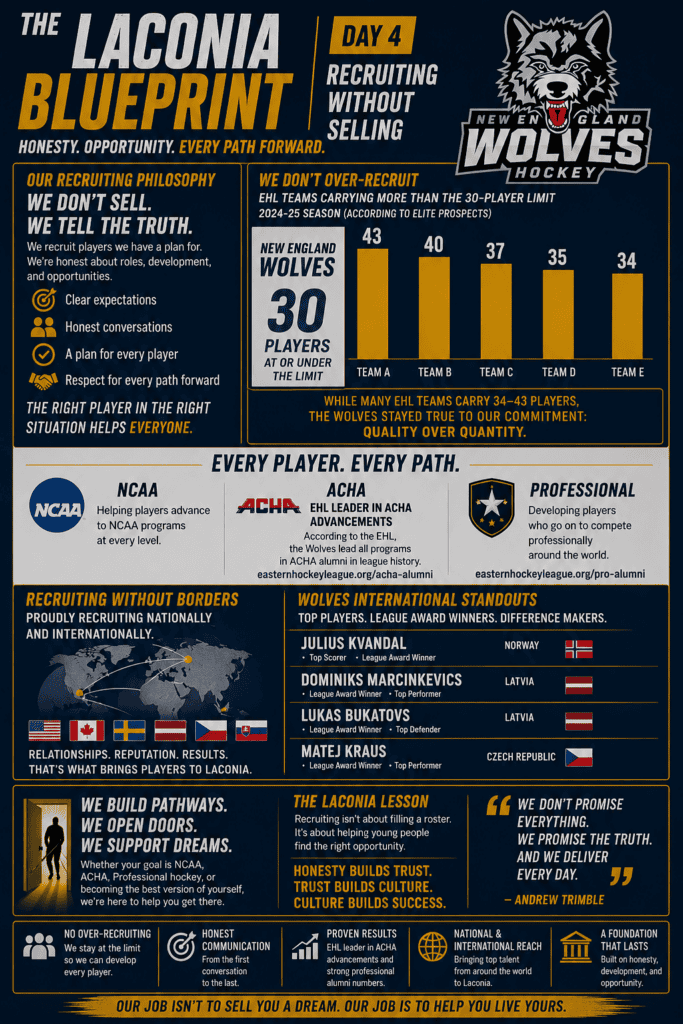
Looking at EHL roster data from Elite Prospects, many organizations routinely carried well beyond the standard 30-player roster threshold. Some organizations carried 35, 40, or even more players throughout the season. Meanwhile, the Wolves remained at or near the roster limit. The objective wasn’t to accumulate players. The objective was to develop the players who committed to our program. (Elite Prospects)
Our philosophy has always been simple:
If we recruit you, we should have a plan for you.
That doesn’t mean every player receives the same role.
It doesn’t mean every player receives the same ice time.
It means we are honest about where they fit and how they can improve.
Recruiting Starts with Truth
Families are smarter than many organizations realize.
Players talk.
Parents talk.
Coaches talk.
If you’re promising things that never happen, eventually the truth catches up.
We’ve always tried to be honest about:
- Where a player fits
- What level they can reach
- What they need to improve
- What opportunities may exist after junior hockey
Sometimes that honesty costs you a commitment.
That’s okay.
Because the wrong player in the wrong situation helps nobody.
There Is More Than One Successful Path
One of the things I’m most proud of is that we’ve never defined success by one destination.
Some players want NCAA hockey.
Some players pursue ACHA opportunities.
Some players continue into professional hockey.
Some players simply want to continue playing while earning a degree.
All of those are successful outcomes.
In fact, according to Eastern Hockey League advancement data, the Wolves have become one of the league’s strongest pathways for players advancing to ACHA hockey. The program has been recognized as a leader in EHLP-to-ACHA advancement, helping numerous athletes continue both their academic and athletic careers. (New England Wolves)
We’ve also produced numerous professional players who have gone on to compete throughout North America and Europe. Elite Prospects continues to track former Wolves players competing professionally and collegiately around the world. (Elite Prospects)
The lesson is simple:
Success isn’t one destination.
Success is helping players reach the destination that’s right for them.
Recruiting Nationally and Internationally
One of the advantages we’ve developed over time is the ability to recruit both nationally and internationally.
If Day 2 of this series was about “Fishing in Other Ponds,” this is what that looks like in practice.
The Wolves have welcomed players from across the United States, Canada, and Europe.
Those international relationships have helped bring tremendous talent into the program.
Players such as:
- Julius Kvandal
- Dominiks Marcinkevics
- Lukas Bukatovs
- Matej Kraus
have all helped demonstrate that Laconia can be a destination for talented players from around the world. Many international Wolves players have gone on to become league award winners, top performers, college athletes, and professional players. (Elite Prospects)
The reality is that geography is no longer a recruiting limitation.
Relationships matter more than geography.
Reputation matters more than geography.
Results matter more than geography.
Great Organizations Attract Players
Many junior teams spend enormous amounts of time trying to convince players to join.
We’ve always believed the better approach is to build something worth joining.
Development.
Housing.
Community.
Academics.
Culture.
Advancement.
Those things become your recruiters.
Over time, players begin talking.
Parents begin talking.
Advisors begin talking.
Coaches begin talking.
Your alumni begin talking.
And recruiting becomes less about selling and more about sharing what already exists.
The Laconia Lesson
The best recruiting strategy isn’t a recruiting strategy at all.
It’s building an organization that consistently delivers on its promises.
We’ve never tried to be everything to everyone.
We’ve tried to be honest.
We’ve tried to provide opportunities.
We’ve tried to help players pursue whatever path makes sense for them.
NCAA.
ACHA.
Professional hockey.
Or simply becoming a better student, athlete, and person.
Because at the end of the day, recruiting isn’t about filling a roster.
It’s about helping young people find the right opportunity.
And the organizations that do that consistently are usually the organizations that never have to sell very hard.
Key Takeaways for Operators
• Don’t over-recruit.
• Recruit players you have a plan for.
• Be honest about opportunities.
• Define success in multiple ways.
• NCAA, ACHA, and Pro hockey are all valuable outcomes.
• Build national and international recruiting pipelines.
• Reputation is your best recruiter.
• Great organizations attract players.
Free Junior Hockey Operator Consultation
As part of The Laconia Blueprint series, I am offering a limited number of free Zoom consultations for junior hockey owners, operators, coaches, and leadership groups.
Topics include:
- Recruiting Systems
- Player Advancement
- Housing Programs
- Development Models
- Organizational Growth
- Community Engagement
Schedule Your Free Zoom Consultation Below
scoringconcepts@gmail.com
Sources: EHL advancement data and Wolves advancement records. (New England Wolves)