The Laconia Blueprint Part 5
Housing: Do It Right to Win in the Long Run
One of the least talked about competitive advantages in junior hockey has nothing to do with coaching, recruiting, or player development.
It’s housing.
Every year, parents entrust junior hockey organizations with something far more important than a hockey player.
They entrust them with their son.
For many athletes, junior hockey is the first time they have lived away from home.
That experience can shape their hockey career, their education, and their personal development.
That’s why I’ve always believed housing is not an operational task.
Housing is a development tool.
The Shortcut Many Organizations Take
Throughout junior hockey, there are organizations that rely on dorm-style living arrangements or large player houses.
Sometimes you’ll find eight, ten, or even more players living together.
While these arrangements can appear convenient, they often create challenges.
Limited supervision.
Poor nutrition.
Distractions.
Less accountability.
Players essentially raising other players.
The reality is that most 18- to 20-year-olds do not need less structure.
They need more.
Why the Wolves Chose Billet Families
Since arriving in Laconia, the Wolves have remained committed to the billet family model.
Rather than placing players in dormitories or large player houses, our athletes live with local families throughout the community.
This creates something that many organizations struggle to replicate:
A home environment.
Players have structure.
Players have accountability.
Players have support.
Players have relationships.
Most importantly, players have people who genuinely care about them beyond hockey.
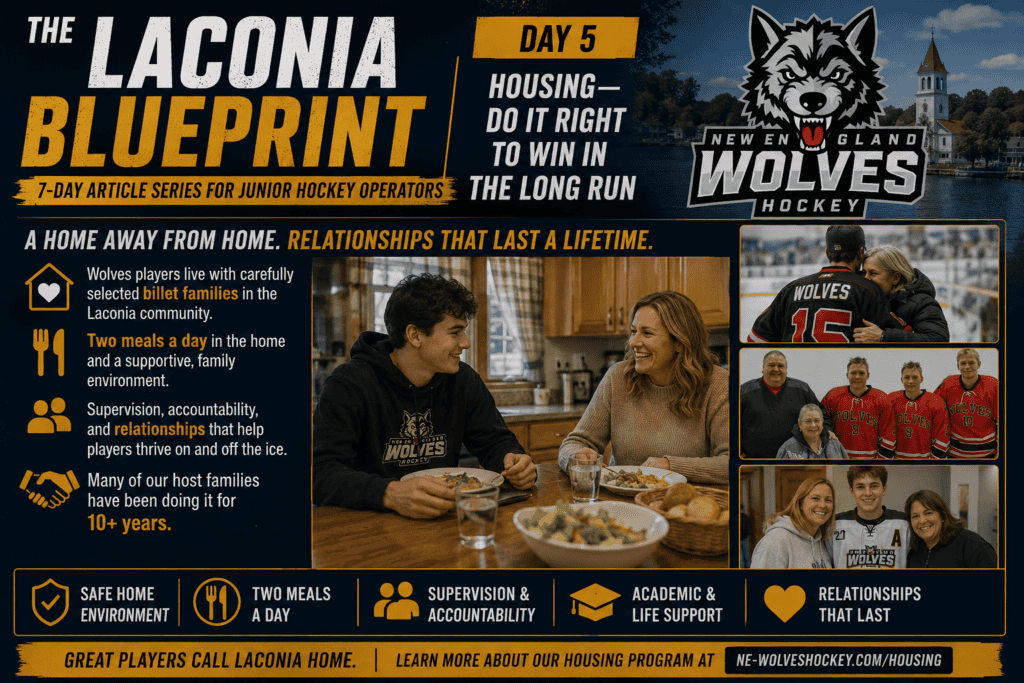
According to our housing model, Wolves players receive housing with carefully selected host families, including meals and family support throughout the season.
Relationships Matter
One of the most remarkable things about our housing program is the consistency.
Many of our host families have been opening their homes to Wolves players for more than ten years.
Think about that.
For over a decade, these families have welcomed athletes from across North America and Europe into their homes.
Over time, these relationships become much more than housing arrangements.
Players become part of the family.
Host parents attend games.
They celebrate successes.
They support players through adversity.
Many remain connected long after junior hockey ends.
You simply don’t create those relationships in an animal house.
Nutrition and Daily Support
One of the biggest advantages of the billet family model is daily living support.
At the Wolves, players receive:
- A safe family environment
- Supervision and accountability
- Two meals per day within the home
- Transportation support when necessary
- Guidance and mentorship
- A stable living environment
For many players, these simple daily habits become the foundation for success.
Good sleep.
Good meals.
Good routines.
Good decisions.
Player development isn’t just what happens at the rink.
It’s what happens between practices.
Housing Is Part of Your Culture
One mistake many operators make is viewing housing as separate from organizational culture.
In reality, housing may be one of the biggest drivers of culture.
When players are living in positive environments, everything improves.
Academics improve.
Nutrition improves.
Attendance improves.
Behavior improves.
Accountability improves.
The best billet families become extensions of your coaching staff.
Not because they’re teaching systems.
Because they’re helping develop responsible young adults.
The Laconia Lesson
When organizations ask me about building sustainable junior hockey programs, I often tell them this:
Your housing system is your culture system.
Players can tolerate a lot of things.
But if they don’t feel comfortable where they live, everything becomes harder.
For nearly a decade, the Wolves have invested in building relationships with billet families who care about our athletes.
Those relationships have become one of the most valuable assets our organization possesses.
The lesson is simple:
Don’t look for the easiest housing solution.
Look for the best housing solution.
Because when players feel at home, they perform better.
And when organizations prioritize people over convenience, everyone wins.
Key Takeaways for Operators
• Housing is a development tool.
• Avoid “animal house” environments.
• Billet families provide structure and accountability.
• Relationships matter.
• Nutrition matters.
• Housing impacts culture.
• Long-term billet families create organizational stability.
• Players perform better when they feel at home.
Free Junior Hockey Operator Consultation
As part of The Laconia Blueprint series, I am offering a limited number of free Zoom consultations for junior hockey owners, operators, coaches, and leadership groups.
Topics include:
- Housing Systems
- Recruiting
- Player Development
- Organizational Structure
- Community Engagement
- Long-Term Sustainability
Schedule Your Free Zoom Consultation Below
scoringconcepts@gmail.com
About Andrew Trimble
Andrew Trimble is the co-owner of the New England Wolves Hockey Club, founder of Scoring Concepts, creator of AI Hockey Advisor, author, and hockey development coach.
Through nearly a decade of operating junior hockey programs in Laconia, New Hampshire, he has helped build one of New England’s most stable player development environments through a focus on culture, community, development, and long-term sustainability.