Summer Isn’t About Staying Busy. It’s About Getting Better.
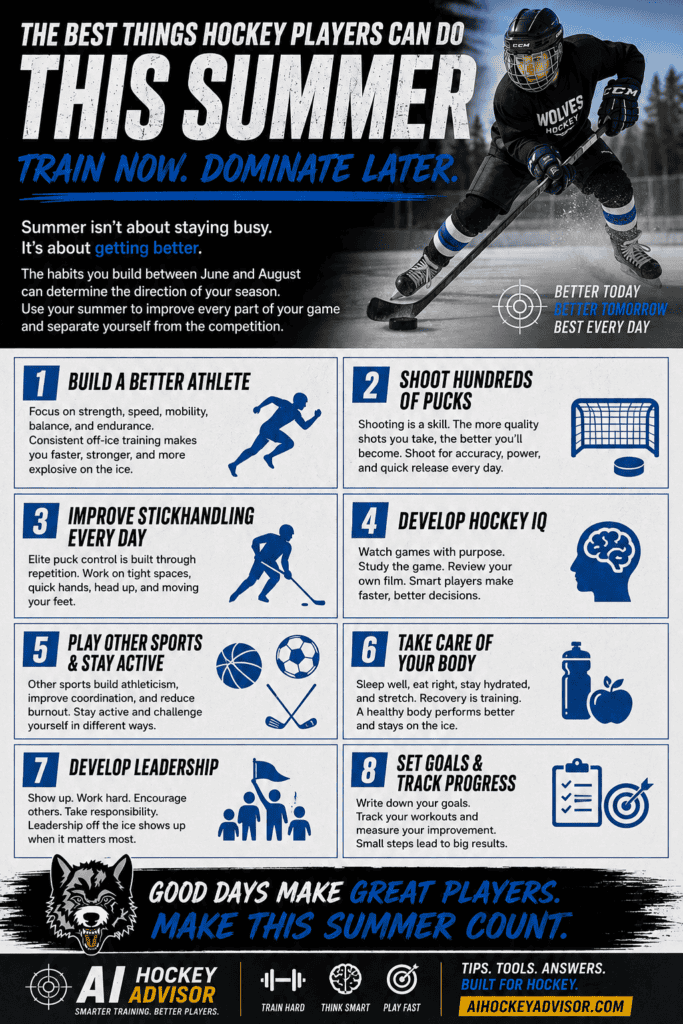
There is an old saying in hockey that championships are won in the summer. While that may be a bit of an exaggeration, there is no question that the habits players build between June and August often determine the direction of their season. Every player has the same number of days in the offseason. The difference is how those days are used.
The best players don’t simply skate more. They train with purpose. They identify weaknesses, create a plan, and steadily improve one day at a time. Summer should never feel like a punishment. It is an opportunity to separate yourself from the competition before the first puck is ever dropped.
Here are some of the areas every hockey player should focus on this summer.
1. Build a Better Athlete
Before becoming a better hockey player, become a better athlete.
Speed, balance, mobility, strength, coordination, and endurance all translate directly to the ice. Young players don’t need complicated workouts. They need consistency. Bodyweight exercises, sprint work, agility drills, jumping, medicine balls, resistance bands, and proper movement mechanics all help develop athleticism that carries into every shift.
The fastest player isn’t always the strongest. The strongest player isn’t always the quickest. Summer gives players time to improve both.
2. Shoot Hundreds of Pucks Every Week
There may not be a better investment than shooting pucks.
Players don’t need a fancy shooting facility. A net, a handful of pucks, and twenty or thirty minutes each day can produce tremendous improvement. Work on wrist shots, snapshots, backhands, one-timers, quick releases, changing shooting angles, and accuracy.
The players who score consistently during the season usually aren’t the ones who only shoot during practice. They’re the ones who have taken thousands of quality shots long before September arrives.
3. Improve Stickhandling Every Day
Elite puck control is built through repetition.
Spend time handling the puck while moving your feet. Work on quick touches, pulling pucks around obstacles, changing hand positions, and keeping your head up. Challenge yourself with tennis balls, golf balls, or reaction drills that force you to process information quickly.
Great stickhandlers don’t stare at the puck. They learn to trust their hands while reading the game around them.
4. Develop Hockey IQ
Not every improvement happens on the ice.
Watch NHL games with purpose. Study how players create space, support teammates, defend odd-man rushes, and make decisions under pressure. Review your own game film if it’s available. Ask yourself why plays develop the way they do instead of simply watching where the puck goes.
Players who think the game faster often appear to skate faster because they arrive at the right place sooner.
5. Play Other Sports and Stay Active
Summer doesn’t always have to mean organized hockey.
Basketball improves footwork. Soccer develops conditioning and vision. Tennis challenges reaction time. Golf teaches patience and focus. Swimming builds endurance while reducing impact on the body.
The best athletes often have a wide variety of movement experiences that make them more adaptable once hockey season returns.
6. Take Care of Your Body
Recovery is training.
Sleep eight to ten hours whenever possible. Eat quality foods that fuel performance. Stay hydrated during hot summer days. Stretch consistently and improve mobility to reduce the risk of injury.
Players who recover well are able to train harder, more consistently, and with better quality throughout the offseason.
7. Develop Leadership
Leadership isn’t reserved for captains.
Show up early. Encourage teammates. Help younger players. Thank your coaches. Take responsibility when things don’t go your way.
Character developed during the offseason often becomes confidence during the season.
8. Set Goals and Track Progress
Don’t simply hope you’ll improve.
Write down measurable goals. Track your workouts. Record how many shots you take. Log your stickhandling sessions. Celebrate small improvements each week.
Progress becomes much easier to see when you measure it.
Final Thoughts
The players who make the biggest jump each season rarely do it because of one magical drill or one incredible camp. They improve because they stack good days together over the course of an entire summer. They train consistently, recover intelligently, and stay committed even when nobody is watching.
When September arrives, confidence doesn’t come from wishing you had worked harder. It comes from knowing you did.
This summer, don’t just stay busy.
Train with purpose. Build better habits. Become a better athlete. And when the season begins, you’ll be prepared—not because you hoped for success, but because you earned it.
About the Author
Andrew Trimble is the founder of Scoring Concepts, co-owner of the New England Wolves, and creator of AI Hockey Advisor. Through coaching, writing, and digital education, he helps players, parents, and coaches build long-term success on and off the ice.
Enjoyed this article? Follow The Hockey Focus for weekly articles on player development, coaching strategies, hockey analytics, and practical ideas to help players reach their potential.