
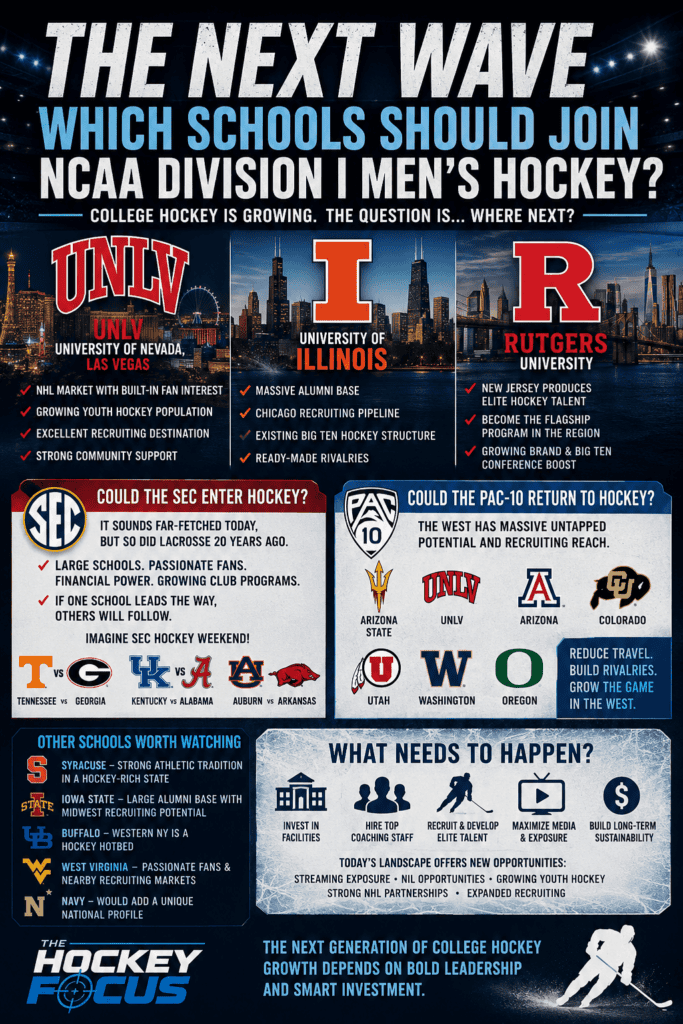
The Next Wave: Which Universities Should Join NCAA Division I Men’s Hockey?
College hockey has never been more popular. Attendance is growing, television coverage has expanded, and the transfer portal has made roster building more attainable than ever before. At the same time, the sport remains concentrated in relatively few regions of the United States.
The question isn’t whether Division I hockey can continue to grow. The question is where it should grow next.
If the NCAA wants to elevate college hockey nationally, several universities stand out as realistic candidates capable of making an immediate impact.
1. University of Nevada, Las Vegas (UNLV)
If there is one program that feels inevitable, it’s UNLV.
Hockey has exploded in Las Vegas since the arrival of the Golden Knights. Youth participation has surged, the city has embraced the sport, and professional hockey has proven that the market can support a winning product. A Division I college program would complete the hockey ecosystem in southern Nevada.
UNLV already has a passionate club program, strong facilities in the area, and a recruiting advantage few schools could match. Imagine telling an 18-year-old recruit they can play high-level college hockey while attending school in one of the fastest-growing sports cities in North America.
Why it works
- NHL market with built-in fan interest
- Growing youth hockey population
- Excellent recruiting destination
- Strong community support
2. University of Illinois
Illinois may be the most surprising omission from Division I hockey.
Chicago has produced NHL players for decades, and Illinois sits in the middle of one of America’s largest youth hockey markets. Yet elite Illinois players often leave the state to play college hockey elsewhere.
The Fighting Illini brand is nationally recognized, and the Big Ten already sponsors hockey. Adding Illinois would create natural rivalries with Michigan, Michigan State, Wisconsin, Minnesota, Ohio State, Penn State, and Notre Dame.
The conference footprint already exists.
Why it works
- Massive alumni base
- Chicago recruiting pipeline
- Existing Big Ten hockey structure
- Ready-made rivalries
3. Rutgers University
Rutgers may not immediately come to mind when discussing hockey expansion, but the potential is enormous.
New Jersey consistently develops elite hockey talent. Between youth programs, prep schools, and junior hockey, the state produces Division I players every year.
Instead of watching those athletes leave for schools across New England and the Midwest, Rutgers could become the flagship hockey program in the region.
The Scarlet Knights brand is growing nationally, and another Big Ten member investing in hockey would further strengthen the conference.
Could the SEC Eventually Enter Hockey?
It sounds far-fetched today.
But so did NCAA lacrosse expansion twenty years ago.
The SEC has proven it can invest heavily in athletics when there is enough interest and financial upside. Schools like Tennessee, Georgia, Arkansas, Kentucky, and Alabama already have large student populations, passionate fan bases, and growing club hockey programs.
If one school made the leap and proved successful, others could follow.
Imagine an SEC Hockey Weekend featuring:
- Tennessee vs. Georgia
- Kentucky vs. Alabama
- Auburn vs. Arkansas
The branding alone would generate significant national attention.
Could the Pac-10 (or a Future Western Conference) Return to Hockey?
Western college hockey has tremendous untapped potential.
Arizona State proved that a non-traditional hockey school can compete nationally. If more western universities invested in the sport, a conference featuring schools such as:
- Arizona State
- UNLV
- Arizona
- Colorado
- Utah
- Washington
- Oregon
could dramatically reduce travel while creating regional rivalries that build fan interest.
Expansion into the western United States would also provide more opportunities for players coming through California, Arizona, Nevada, Colorado, Utah, Washington, and Oregon youth hockey.
Other Schools Worth Watching
Several additional universities could realistically support Division I men’s hockey in the future:
- Syracuse – Strong athletic tradition in a hockey-rich state.
- Iowa State – Large alumni base with growing Midwest recruiting opportunities.
- University at Buffalo – Western New York is a hotbed for hockey.
- West Virginia – Could capitalize on passionate fan support and nearby recruiting markets.
- Navy – Would add a unique national profile to college hockey.
What Needs to Happen?
Starting a Division I hockey program isn’t inexpensive. Schools must invest in scholarships, coaching staffs, recruiting budgets, facilities, and operational costs.
However, today’s landscape also presents opportunities that didn’t exist a decade ago:
- Increased streaming exposure
- NIL opportunities for athletes
- Growing youth participation in non-traditional markets
- Stronger relationships with NHL organizations
- Expanded recruiting through junior leagues across North America
Programs that think long-term could position themselves at the forefront of the next era of college hockey.
Final Thoughts
College hockey doesn’t need to expand recklessly—but it does need to think boldly.
Schools like UNLV, Illinois, and Rutgers have the brand recognition, recruiting access, and market potential to thrive at the Division I level. Looking even further ahead, the possibility of western conferences or even an SEC presence may sound ambitious today, but so did many of the sport’s biggest success stories.
The next generation of college hockey growth may not come from the traditional hockey hotbeds. It may come from universities willing to invest in the future of the game, bringing new fans, new rivalries, and new opportunities to one of the fastest-growing sports in North America.