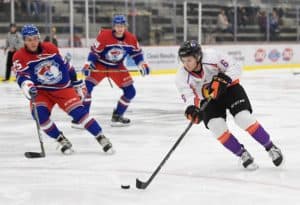
More Practices, Better Games: Finding the Right Balance in Youth Hockey
By Andrew Trimble | The Hockey Focus
A packed game schedule can look impressive. Tournaments, showcases and weekend doubleheaders give families plenty to circle on the calendar. But when evaluating a youth hockey program, we should ask another question: How much time do players actually have to practice?
Games allow skaters to compete and apply what they have learned. Practice gives them opportunities to build skills, receive feedback and try again. A strong development program makes room for both.
Recommended balance by age
USA Hockey’s American Development Model broadly encourages three practices for each game at younger ages. Its older-youth guidance supports approximately two to three practices per game. These are development guidelines, and published program examples vary somewhat. portal.usahockey.com
| Age or stage | Recommended development balance | Main priorities |
|---|---|---|
| Learn to Play / 6U | Emphasize learning and playful competition rather than a formal game quota | Skating, balance, confidence and enjoyment |
| 8U | Aim toward 3:1; some published examples are closer to 2:1 | Stations, cross-ice play and puck touches |
| 10U | Approximately 3:1 | Skating, puck skills and decision-making |
| 12U | Approximately 2.5:1–3:1 | Individual skills, support and game awareness |
| 14U / 16U | Approximately 2:1–3:1 | Skills at speed, positioning and competitive situations |
| 18U | Approximately 2:1–3:1 | Position-specific development and tactical execution |
These targets synthesize USA Hockey’s ADM overview, program structures and older-age recommendations. The 18U model lists 130–140 practices and 50–60 games. They should guide planning rather than become rigid weekly quotas. portal.usahockey.com
One distinction matters: a schedule described as 70% practice and 30% games equals approximately 2.3 practices per game, not exactly 3:1. Look at the actual session totals when comparing programs.
Why practice deserves more space
During games, skaters rotate through shifts. In a well-designed practice, coaches can provide repeated opportunities to skate, handle the puck, pass, shoot and solve problems. USA Hockey emphasizes the additional active ice time that practice can offer compared with games. usahockey.com
However, quality matters. An hour spent standing in long lines does not offer the same experience as stations, purposeful skill work and competitive small-area games. Practices should help players recognize situations and make decisions, with plenty of opportunities to try again.
House, travel and elite hockey
My recommendation is to begin with age and developmental needs, then adapt to the program’s resources. An AAA label does not remove a young player’s need for repetition. A house program with limited ice should protect the practice opportunities it can provide.
If a team has three weekly ice sessions, two practices and one game may be a practical compromise. If a travel team plays twice every weekend, maintaining a 3:1 ratio would require six practices per week. That math should prompt a review of the game load before adding more demands to a child’s schedule.
The goal is a workable balance that supports improvement, school, recovery and enjoyment.
Count the whole calendar
Review the ratio over a month and across the season. Every week does not need to look identical.
For example, 12 practices and four games produce a 3:1 ratio. Add a four-game tournament without changing the practice schedule, and that balance becomes 1.5:1.
Count each separate tournament game when reviewing your schedule. Also check whether a published recommendation refers to individual games or game days; those are different measures.
Off-ice training, driveway stickhandling and video review can support development. Track them separately so they do not disguise a shortage of on-ice practice.
What parents should ask
Before committing to a program, ask:
- How many practices and games are planned?
- Do those game totals include tournaments and showcases?
- What does a typical practice look like?
- How much time will my child spend actively participating?
As coaches, we should build schedules that give players time to improve. Games are exciting, but the work between games helps skaters become more confident when the puck drops.
Give kids meaningful competition. Give them purposeful practices. And give them a reason to keep loving the game.