College Hockey Commitments After the CHL Rule Change
College hockey recruiting has entered an entirely new era. Beginning August 1, 2025, players who competed in the Ontario Hockey League, Western Hockey League or Quebec Maritimes Junior Hockey League could retain Division I eligibility, provided they were not paid beyond actual and necessary expenses. The change eliminated the wall that had forced young players to choose between the CHL and the NCAA before their careers were fully developed. The NCAA called it a change to permitted “preenrollment activities,” but its effect on recruiting has been much larger.
The first NCAA class under the new rule demonstrated how quickly coaches embraced the CHL. Of the 516 freshmen entering Division I hockey for 2025-26, 174 came from the CHL—nearly 34 percent of the class. Fifty of the 64 Division I programs had at least one CHL freshman, and 32 programs brought in three or more. Those players came from 57 of the CHL’s 60 clubs, showing that this was a national recruiting shift rather than a strategy used by only a few prominent programs. The Hockey Think Tank’s roster analysis documented the scale of that first group.
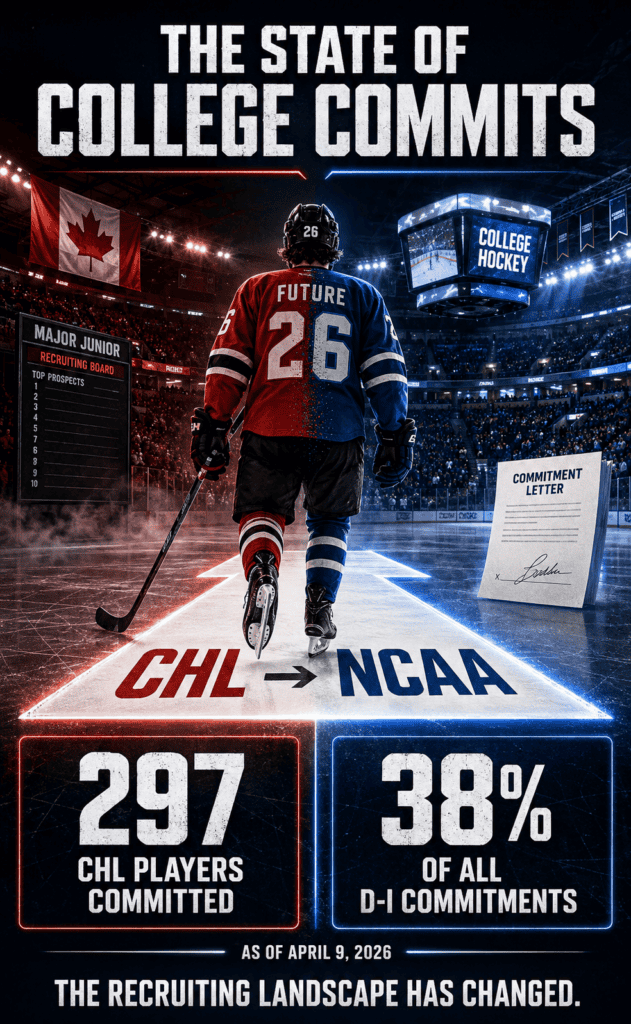
The commitment numbers suggest this will continue. As of April 9, 2026, there were 297 players from the OHL, WHL and QMJHL committed to Division I programs, accounting for approximately 38 percent of all Division I commitments at that time. Another examination of the future commitment list counted 279 CHL players, compared with 202 from the USHL, 124 from the BCHL and 35 from the National Team Development Program; totals vary slightly depending on the date and how future classes are classified. College Hockey Inc. maintains the active commitment list, while the Star Tribune reported the 297-player figure.
Those additions have created pressure on the traditional college-development pipelines. From the 2024 freshman class to 2025, the number of incoming players from the USHL dropped from 179 to 150, the BCHL fell from 126 to 89 and the NAHL declined from 105 to 60. The NCDC went from six incoming Division I freshmen to three, although a single season is not enough to establish a permanent trend. The impact was intensified by roster restrictions and the loss of American International as a Division I program, which collectively reduced the available player population by 67 spots.
The change is not merely providing roster depth; it is sending experienced and highly talented players into college hockey. The OHL alone placed 78 graduates on NCAA opening-night rosters in 2025-26, including players at Michigan, Michigan State, Penn State, Notre Dame and several Hockey East programs. Air Force coach Frank Serratore summarized the moment clearly: “We’re witnessing a paradigm shift the size of which college hockey’s never seen.” His larger point was that Division I hockey was already an exclusive level, and the addition of another elite player pool has made it even more competitive. OHL opening-night roster data
For players and families, the lesson is not that the USHL, NAHL, NCDC, prep school or high school pathways have stopped working. It means that a commitment now requires a more honest evaluation of the player’s projected role, arrival year and readiness to compete against older CHL graduates. Players must continue developing after committing because coaches have more recruiting options, the transfer portal remains active and verbal commitments are still subject to admission and NCAA certification. Academics, character, coachability and positional need may become even more valuable when several players possess comparable hockey ability.
The CHL eligibility change has ultimately produced more freedom for elite players and a stronger NCAA product, but it has also reduced the margin for error throughout junior hockey. College coaches can recruit from nearly every major North American development league without the old eligibility barrier, while CHL organizations can recruit American players without asking them to surrender the college option. The commitment is still an important achievement, but it should be viewed as the beginning of the next competition rather than the end of the recruiting process. In the current landscape, development, communication and finding the right fit matter more than simply collecting the earliest offer.
Continue Your Hockey Development
For more practical insight into college recruiting, player development and the changing hockey landscape, follow Coach Andrew Trimble and the Scoring Concepts ecosystem. Subscribe to The Hockey Development Hub on Substack, watch drills and development discussions on the Scoring Concepts YouTube channel, explore camps and training at ScoringConcepts.com, and receive personalized guidance at AIHockeyAdvisor.com. Join today and put useful hockey information to work in your game or program.