Understanding Your Market: Before You Build a Team, Understand the Pond
In junior hockey, everyone wants to talk about coaches, recruiting, player development, and facilities.
Those things matter.
The Hockey Development Hub is a reader-supported publication. To receive new posts and support my work, consider becoming a free or paid subscriber.
But before any of those conversations happen, there is a more important question every operator should ask:
Can this market support a hockey team?
I’ve watched organizations spend hundreds of thousands of dollars launching teams only to discover they never truly understood the market they were entering.
They found a rink.
They ordered jerseys.
They hired coaches.
Then they started asking questions they should have asked first.
Where are the players coming from?
Who will house them?
Who will sponsor the team?
Who will attend the games?
Who will promote the organization?
The reality is simple:
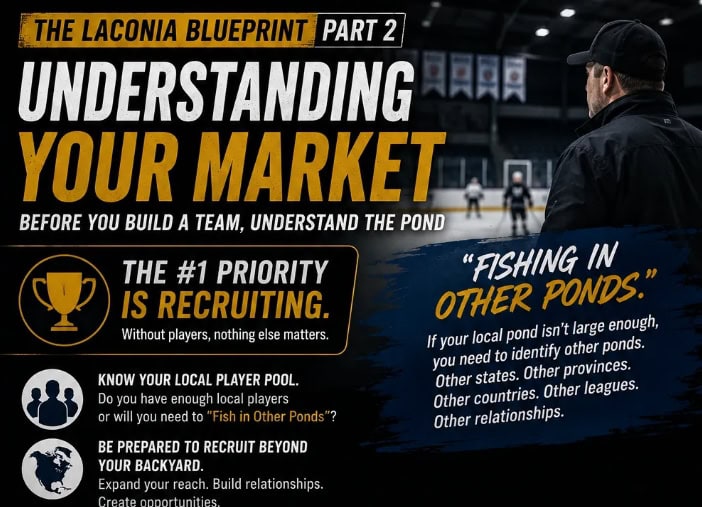
Recruiting is the lifeblood of every junior hockey organization.
Without players, nothing else matters.
That’s why the first thing I tell anyone considering launching a program is to understand where your players will come from.
Some markets have a strong local player base.
Others don’t.
Some communities can consistently produce enough players to support a junior organization.
Others require you to recruit from outside your geographic area.
There is nothing wrong with either approach.
But you need to know which one you’re dealing with.
At the Wolves, we’ve always understood that we needed to do both.
We recruit local players when appropriate.
But we also understand that we must continually recruit beyond our backyard.
I often call this:
“Fishing in Other Ponds.”
If your local pond isn’t large enough, you need to identify other ponds.
Other states.
Other provinces.
Other countries.
Other leagues.
Other relationships.
The mistake many operators make is assuming players will simply show up.
They won’t.
You need a recruiting plan long before you need a roster.
Once you’ve identified where your players will come from, the next step is evaluating the rest of the market.
Know Your Rink Situation
This may sound obvious, but it surprises me how many organizations enter markets without securing long-term facility commitments.
You need to know:
- Who owns the rink?
- Are they supportive of junior hockey?
- Will they commit ice time long-term?
- Can your players train consistently?
- Is there room for growth?
Facilities can make or break an organization.
Strong relationships with rink ownership create stability.
Weak relationships create uncertainty.
Build Housing Before You Need Housing
Housing is often treated as an afterthought.
That’s a mistake.
If players are your product, housing is part of the player experience.
You need billet families.
You need community support.
You need people who believe in what you’re building.
The best time to recruit housing isn’t August.
It’s twelve months before August.
Find Sponsors Early
Many organizations view sponsors as financial support.
I view sponsors as community partners.
Sponsors introduce you to new people.
They create credibility.
They help spread your message.
Most importantly, they become invested in your success.
Strong organizations build sponsor relationships before they need sponsor dollars.
Develop Media Relationships
One of the most overlooked parts of building a hockey organization is publicity.
You need people talking about your team.
You need stories being shared.
You need visibility.
That means building relationships with:
- Local newspapers
- Radio stations
- Community publications
- Social media influencers
- Community leaders
If nobody knows you exist, they can’t support you.
Community engagement starts with visibility.
Culture Creates Retention
Many operators think recruiting is about attracting players.
The truth is that recruiting is only half the battle.
Retention matters just as much.
Players stay where they feel valued.
Families stay where communication is strong.
Billet families stay where they feel appreciated.
Sponsors stay where they see impact.
Culture drives retention.
And retention drives stability.
The Laconia Lesson
One of the reasons the Wolves have been able to remain in Laconia for more than a decade is because we invested in the market.
We built relationships.
We worked with the rink.
We developed housing.
We partnered with businesses.
We connected with community leaders.
We created systems.
The result wasn’t immediate.
It took years.
But over time, those relationships became one of the strongest competitive advantages our organization has.
Because before you build a hockey team, you need to understand the pond you’re fishing in.
And if that pond isn’t big enough, you’d better know where the other ponds are.
Key Takeaways for Operators
• Recruiting is the #1 priority.
• Understand your local player pool.
• Be prepared to “Fish in Other Ponds.”
• Secure rink relationships early.
• Build housing before you need it.
• Develop sponsor partnerships.
• Create media relationships.
• Culture drives retention.
• Strong organizations are built within strong communities.
Free Junior Hockey Operator Consultation
As part of The Laconia Blueprint series, I’m offering a limited number of free Zoom consultations for junior hockey owners, operators, coaches, and leadership groups.
If you’d like to discuss recruiting strategy, market evaluation, housing systems, sponsorship development, organizational growth, or long-term sustainability, I’d be happy to connect.
Schedule Your Free Zoom Consultation Below
scoringconcepts@gmail.com