This may be the most important article in the entire series because community support is what transforms a hockey team into a lasting organization.
The Laconia Blueprint Part 6
Building Community Support Beyond the Rink
When people talk about successful junior hockey organizations, they usually focus on recruiting.
Or player development.
Or wins and losses.
Those things matter.
But after nearly a decade operating the New England Wolves in Laconia, I’ve learned something important:
The strongest organizations are built far beyond the rink.
One of the reasons many junior hockey teams struggle is because they become isolated from their communities.
The team exists.
Games are played.
Players come and go.
But the organization never truly becomes part of the town.
Eventually support fades.
Attendance declines.
Relationships disappear.
The foundation becomes unstable.
We wanted something different.
Learning from the Laconia Leafs
Before the Wolves arrived, the Laconia Leafs spent years competing in the Atlantic Junior Hockey League.
While the Leafs struggled on the ice, one thing they were widely respected for was their commitment to community service.
When we took over hockey operations in Laconia, we made a conscious decision.
We weren’t going to replace everything.
We were going to preserve the best parts of what came before us.
Community involvement was one of those things.
In many ways, the Wolves embraced that philosophy and expanded upon it.
The goal wasn’t simply to have a hockey team.
The goal was to become part of the community.
More Than 1,000 Hours of Service
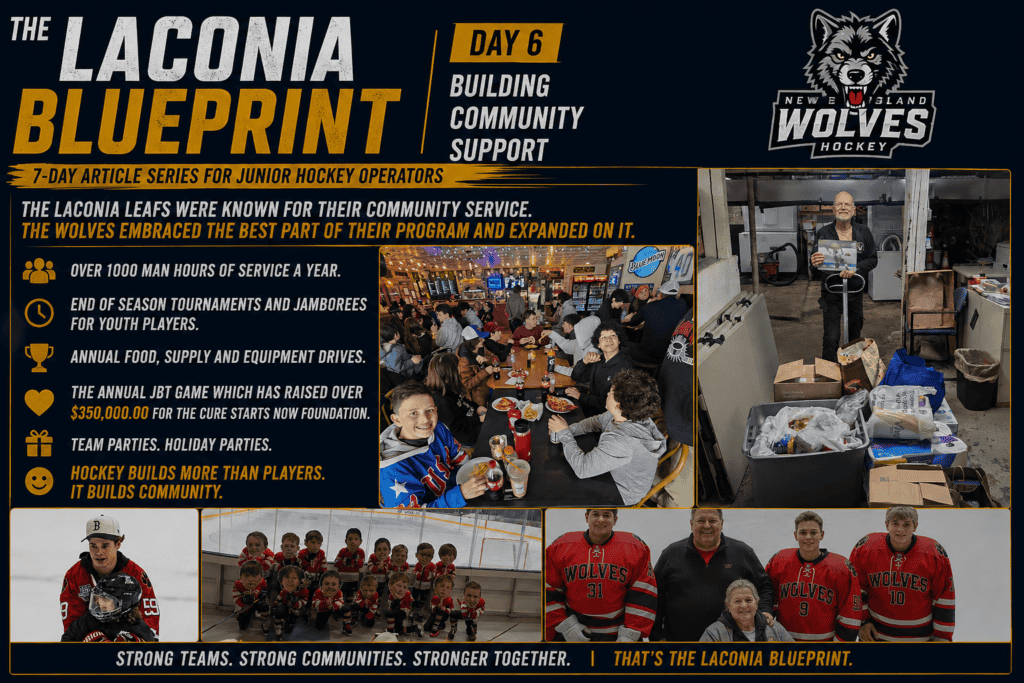
Today, Wolves players complete more than 1,000 hours of community service annually.
Think about that number.
More than 1,000 hours invested back into the Lakes Region.
Not because it’s required for publicity.
Because it’s part of our culture.
Players volunteer.
Players give back.
Players learn that leadership extends beyond the scoreboard.
Community service isn’t something we do after hockey.
Community service is part of hockey.
Food Drives, Equipment Drives, and Supply Drives
Every year our players participate in initiatives designed to help local families and organizations.
Food drives.
Equipment drives.
Supply drives.
These projects accomplish two things.
First, they help people who need assistance.
Second, they teach players perspective.
It’s easy for young athletes to become consumed by goals, points, and statistics.
Community involvement reminds them that there are bigger things in life.
That lesson matters.
The JBT Game
Perhaps no event better represents the Wolves’ commitment to community than the annual JBT Game.
What started as a meaningful event has grown into one of the most impactful traditions in our organization.
Over the years, the JBT Game has helped raise more than $350,000 for the Cure Starts Now Foundation.
Think about that.
A junior hockey event generating more than a third of a million dollars for pediatric cancer research and awareness.
That’s far bigger than hockey.
That’s impact.
Those are the moments people remember.
Building the Next Generation
One of my favorite traditions each year involves our youth hockey players.
The Wolves regularly host:
- Youth tournaments
- Jamborees
- Community events
- End-of-season celebrations
These events create connections between junior players and younger athletes.
The younger players see role models.
The junior players learn leadership.
Everyone benefits.
For many youth players, their first interaction with junior hockey happens through one of these events.
Years later, some become Wolves players themselves.
That’s how communities grow.
Team Parties Matter Too
When people hear the word “culture,” they often think about practices and games.
Culture is much bigger than that.
Some of our strongest relationships have been built through:
- Holiday parties
- Team dinners
- Community gatherings
- Family events
- Billet family celebrations
These moments create memories.
They create connections.
They create loyalty.
The strongest organizations understand that people stay connected to experiences, not schedules.
Community Is a Competitive Advantage
Many organizations view community engagement as something nice to do.
I view it differently.
I believe it’s a competitive advantage.
Communities support organizations that support them.
Host families become ambassadors.
Sponsors become advocates.
Fans become supporters.
Relationships create opportunities.
Over time, those relationships become one of the most valuable assets an organization can possess.
You can’t buy that.
You have to earn it.
The Laconia Lesson
The biggest lesson we’ve learned in Laconia is simple:
Hockey organizations that only take from a community rarely last.
Organizations that invest in a community become part of it.
The Wolves have tried to build something bigger than a hockey team.
We’ve tried to build relationships.
We’ve tried to build traditions.
We’ve tried to build impact.
Because when hockey becomes part of the community, the community begins supporting hockey.
And that’s when organizations become sustainable.
Hockey Builds More Than Players.
Hockey Builds Community.
Key Takeaways for Operators
• Community support must be intentional.
• Preserve the best traditions that came before you.
• Service creates connection.
• Youth events help build future players and fans.
• Team culture extends beyond the rink.
• Community engagement creates long-term stability.
• Relationships are an organization’s most valuable asset.
• Sustainable organizations invest in their communities.
Free Junior Hockey Operator Consultation
As part of The Laconia Blueprint series, I am offering a limited number of free Zoom consultations for junior hockey owners, operators, coaches, and leadership groups.
Topics include:
- Community Engagement
- Housing Systems
- Recruiting
- Development Models
- Organizational Growth
- Long-Term Sustainability
Schedule Your Free Zoom Consultation Below
[Insert Scheduling Link]
About Andrew Trimble
Andrew Trimble is the co-owner of the New England Wolves Hockey Club, founder of Scoring Concepts, creator of AI Hockey Advisor, author, speaker, and hockey development consultant.
Through nearly a decade in Laconia, New Hampshire, he has helped build one of New England’s most community-focused junior hockey organizations through a commitment to development, service, relationships, and long-term sustainability.
This article sets up Day 7 perfectly because you’ve now covered all the major pillars: Stability, Market, Development, Recruiting, Housing, and Community. The final scorecard article can tie everything together into a framework that operators can actually use to evaluate their own organizations.