Junior Hockey Enters a New Era: A 2026–27 USHL and NAHL Season Preview
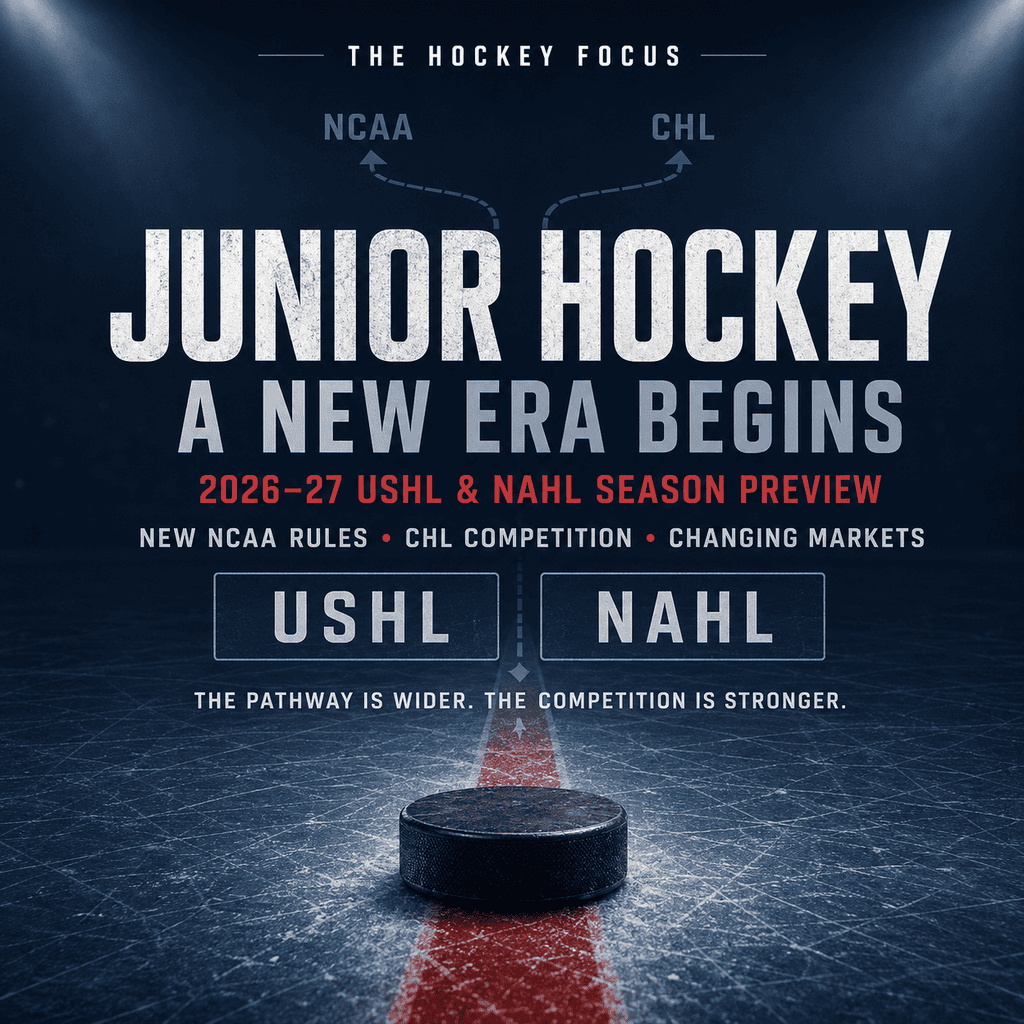
The 2026–27 junior hockey season will begin with the puck dropping on familiar rinks, but the development landscape surrounding those rinks has changed dramatically.
Canadian Hockey League players can now retain NCAA Division I eligibility, ownership groups are investing in new markets and facilities, and college programs have access to a larger and older recruiting pool. The USHL and NAHL remain two of the strongest development leagues in North America, but both must now compete for players in a marketplace with fewer barriers and more legitimate pathways.
The NCAA Rule That Changed Everything
Effective August 1, 2025, the NCAA began allowing men’s hockey prospects who participated with major-junior or professional teams to retain Division I eligibility, provided they were not compensated beyond actual and necessary expenses. That decision opened the NCAA pathway to players from the Ontario Hockey League, Western Hockey League and Quebec Maritimes Junior Hockey League. Previously, participation in those CHL leagues generally ended a player’s NCAA eligibility.
The effect was immediate. The OHL reported that 78 of its graduates appeared on NCAA opening-night rosters in 2025–26. The number of CHL players committing to American colleges has continued to grow for the 2026–27 season and beyond.
For decades, the USHL could tell an elite young player that it offered the clearest combination of high-level junior hockey, NHL exposure and NCAA eligibility. That remains a compelling pitch, but it is no longer an exclusive one.
A player can now choose the CHL without automatically closing the NCAA door. That gives Canadian teams a stronger recruiting position with American players and NCAA-minded families. It also gives college coaches access to experienced 19- and 20-year-old CHL graduates who may be physically and competitively prepared to contribute immediately.
Is the CHL Taking Talent from American Junior Hockey?
The short answer is yes—but the complete answer is more complicated.
Some players who might previously have selected the USHL are now choosing the CHL because they can combine major-junior competition with the possibility of eventually playing college hockey. The CHL can offer extensive travel, large crowds, strong NHL exposure and, in many markets, a professional-style environment at a young age.
The pressure may eventually travel down the American junior ladder. If the CHL attracts more elite 16- and 17-year-olds, USHL teams may pull more aggressively from the NAHL, prep schools, Tier III leagues and 18U programs. NAHL teams must then work harder to identify late developers and retain players who have multiple opportunities.
However, the new system can also create movement in the opposite direction. A young player who is not receiving an appropriate role in the CHL may explore an American junior option. Other players may continue to prefer the USHL’s practice-to-game ratio, education structure, weekend-heavy schedule and direct relationships with NCAA programs.
The result is not the disappearance of one pathway. It is a more competitive marketplace in which every league and organization must prove that its development model is more than a slogan.
USHL Preview: Defending Its Position Through Development and Investment
The USHL will celebrate its 25th season as USA Hockey’s only Tier I junior league in 2026–27. All 16 teams will play 62 games, beginning with the USHL Fall Classic in Chicago from September 16–20. The regular season will conclude on April 3, 2027. USHL 2026–27 schedule announcement
Despite increased competition from the CHL, the USHL still possesses enormous developmental credibility. According to the league, more than half of current NCAA Division I men’s hockey players have USHL experience, nearly one-quarter of NHL players have played in the league, and the USHL has produced more than 315 direct NHL Draft selections since 2020.
The league’s response to the changing environment appears to be investment rather than retreat.
The Chicago Steel, owned by Wirtz Corporation, are moving into the expanded Fifth Third Arena for 2026–27. The facility is connected to the Chicago Blackhawks and will place USHL players inside one of the Midwest’s most prominent hockey-development environments. Chicago Steel facility announcement
The Madison Capitols are also scheduled to move into the new Legacy20 Arena at DeForest Yards. Led by owner and chairman Ryan Suter, the project includes enhanced locker rooms, development resources, a video board, hospitality spaces and multiple areas supporting team operations. Madison Capitols arena announcement
The USHL has also announced six targeted West Coast markets for a possible 2027–28 launch. Prospective ownership and development partners include Joe Sakic in San Diego and Teemu Selänne in Orange County, along with groups connected to Simi Valley, Northern California, Prescott Valley and Phoenix. USHL West Coast expansion announcement
Those moves are important. Junior hockey is no longer competing only through wins, commitments and draft selections. Ownership quality, facilities, housing, education, staffing, medical care and daily development resources increasingly influence where families send their players.
On the ice, expect the USHL to remain fast, young and heavily scouted. The challenge will be protecting meaningful roles for developing players while competing against CHL clubs that can now offer both major-junior hockey and a future NCAA option.
NAHL Preview: Expansion, Relocation and Opportunity
The NAHL enters its 52nd season as one of only two USA Hockey-sanctioned, tuition-free junior leagues. Its 36 teams will compete across five divisions and play 59 regular-season games. The season begins September 11, the league showcase will be held September 23–26 in Blaine, Minnesota, and the regular season concludes April 17, 2027. NAHL 2026–27 events and schedule
The most visible change is the formation of a new Mountain Division. Five organizations located in Montana, Colorado, Utah and Idaho were approved for NAHL membership: the Billings Cattle Punchers, Idaho Falls Spud Kings, Ogden Mustangs, Grand Junction River Hawks and Pueblo Bulls.
Several of these organizations arrive with established markets, modern facilities or existing fan support. Idaho Falls plays in a 4,100-seat arena, while Billings will enter a new facility featuring a 2,200-seat arena and two NHL-sized ice sheets. NAHL Mountain Division announcement
The North Iowa Bulls have also relocated to the Houston metropolitan area and will become the Houston Bulls. The team will play at the new Deep South Ice & Sports Center in Richmond, Texas, joining an already demanding nine-team South Division. The facility is expected to include a 1,800-seat arena, a second NHL-sized practice sheet, suites and additional development space. Houston Bulls relocation announcement
These moves demonstrate how closely junior hockey’s competitive future is tied to ownership and infrastructure. A strong coaching staff remains essential, but teams also need stable housing, quality training environments, community support, reliable transportation and the financial ability to operate responsibly over an eight-month season.
The NAHL’s greatest strength remains opportunity. The league reported more than 352 NCAA commitments during the 2025–26 season, with 54% of those commitments going to Division I programs. It has now exceeded 300 NCAA commitments in 10 consecutive seasons.
The CHL’s entrance into NCAA recruiting may reduce the number of college roster spots available to traditional American junior players, but it may also increase the value of the NAHL’s developmental role. College coaches will still need players who can improve over time, fill specific positions and arrive prepared for the academic and physical demands of college hockey.
Older Recruiting Classes and Fewer Automatic Commitments
The greatest pressure may not be felt by the elite player. It may be felt by the player in the middle.
College programs can now recruit from the USHL, NAHL, CHL, prep hockey, high-performance youth programs and the transfer portal. Coaches may have less incentive to make early commitments when they can evaluate older players with larger bodies of work.
That could lead to fewer automatic commitments based on projection and more decisions based on demonstrated performance. Players may need to remain patient, continue developing and understand that a successful junior career is no longer guaranteed to produce a college roster spot.
Families must also evaluate opportunities more carefully. The name of the league matters, but role, ice time, coaching, strength training, video work, education and organizational stability may matter even more.
A player sitting in the stands in a famous league is not necessarily developing more than a player playing important minutes in a strong program one level below.
What to Watch in 2026–27
Five major storylines will define the upcoming season:
- USHL retention: Can the league continue securing top American prospects when CHL participation no longer eliminates NCAA eligibility?
- NAHL advancement: Will the league maintain its commitment numbers as colleges add more experienced CHL graduates?
- Expansion quality: Can new markets provide stable ownership, strong facilities and legitimate player-development environments?
- Roster age: Will NCAA programs increasingly prefer older junior graduates who can contribute immediately?
- Player movement: Will more prospects move between the CHL, USHL, NAHL, prep hockey and other junior leagues in search of the right role?
The Pathway Is Wider—but Also More Competitive
The new NCAA rules have created more choices for players, but they have not created more lineup spots. Every player still needs quality coaching, honest evaluation, meaningful ice time and a development plan.
The USHL remains the premier USA Hockey Tier I pathway. The NAHL remains a powerful tuition-free route to college hockey. The CHL now offers access to NCAA hockey that did not exist under the old amateurism system.
The winners in this new era will be the leagues and organizations that invest in players every day—not merely those that make the loudest recruiting promises.
For players and families, the central question should no longer be, “Which league sounds most impressive?”
It should be, “Where will this player receive the best opportunity to develop?”
By Andrew Trimble
www.scoringconcepts.com
ww.aihockeyadvisor.com
(5) Andrew Trimble – YouTube LIKE US ON YOUTUBE TODAY!